Pendulum's description
Do the stars, Moon, and Sun orbit around the Earth, or does the Earth rotate around its axis? The second concept was innovative in Galileo's era (16th and 17th centuries), and just very few people believed it. But, because it was able to explain numerous astronomical occurrences with its aid, this finally earned acceptance among scholars. However, without travelling into space to observe "from the outside" or studying astronomical equations, is it possible to perceive the Earth's rotation directly on Earth?
Léon Foucault, a French scientist, provided the first corresponding proof. He noted that the pendulum tended to stay in the same position as it swung. Try to keep the swinging weight on the thread, sit in a swivel chair with it, and gently turn: the pendulum will continue to swing in the same direction, towards the room, even if you aim it at somewhere else.The same is relevant for Earth: if you hung a pendulum over the North Pole, the Earth would spin 360 degrees under it in a day, but the pendulum would swing in the same direction as the surrounding stars. The terrestrial observer, on the other hand, would see that the direction of the swing turns 15 degrees towards him every hour.
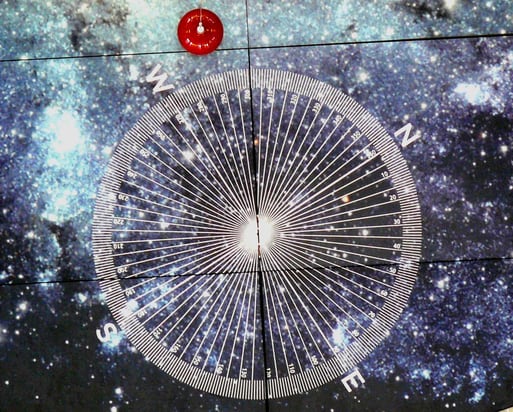
Although doing this experiment on a pole would be impracticable, it works similarly in other parts of the world. All that is required is to combine the pendulum's inclination to retain its swing direction with the requirement that the swing direction maintenance is vertical. As a result, when we approach closer to the equator, the rate of rotation of the pendulum's direction slows down. In 1851, Foucault initially showed his experiment to the public at the Paris Pantheon; the direction of the swing rotates by 11 ° 20 ‘every hour in Paris. Considering Olomouc is further north, rotation takes a little longer: 11 ° 27 ‘per hour. This rotation may be seen live or remotely on this page.
Received data
Gallery
Photo: Viktor Čáp